Key Takeaways
- Composite doors consist of aluminum alloy panels, an internal filling core and a metal frame. Material specifications and structural connections influence strength, thermal insulation and sealing performance.
- Customization options include dimensions, thickness, panel designs, surface colors, glass and hardware. Non-standard requirements must be coordinated with structural design and manufacturing processes.
- Manufacturing involves raw material inspection, panel processing, metal frame assembly, core filling, composite assembly and final finishing.
- Quality inspections should cover dimensional accuracy, whole-door U-value, water tightness, air permeability, impact resistance and hardware durability, supported by relevant test reports.
- Supplier evaluation should focus on material control, structural processing, customization capabilities, quality management and bulk production capacity.
Custom composite doors combine different materials to achieve specific structural, functional and aesthetic requirements. Compared with doors made from a single material, their multi-layer construction allows manufacturers to adjust panel materials, internal cores and supporting frames according to different building applications.
For buyers sourcing custom made composite doors, understanding the material structure, manufacturing process and performance testing requirements is essential. These factors directly influence product durability, thermal insulation, weather resistance and long-term operating stability.
Composite Door Materials and Structural Design
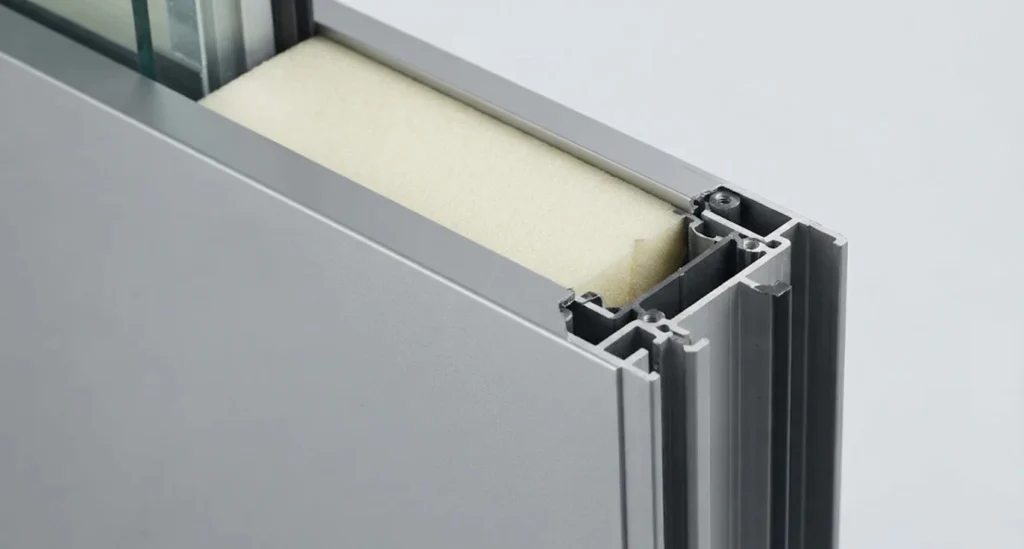
Composite doors combine different materials to provide structural support, internal filling and surface protection. Huaye uses aluminum alloy panels, an internal filling core and a metal frame as the main components of its composite door structure. These components must be compatible in terms of material specifications, dimensions and connection methods.
- Aluminum Alloy Panels: As the exterior layer, they provide surface protection and design flexibility. Material thickness, processing accuracy and surface finishing influence the overall performance of the door.
- Internal Filling Core: The core affects door weight, thermal insulation and internal structural performance. Buyers should confirm its material type, density, thickness and filling uniformity.
- Metal Frame: The frame provides internal support and serves as the foundation for structural connections and hardware installation. Its dimensions, reinforcement and connection accuracy must match the door’s size and weight.
- Surface Finishing: Powder coating provides different color and surface options. Coating uniformity, adhesion and batch consistency are important quality considerations.
Comparison of Main Structural Materials and Finishing Processes
| Component | Main Function | Key Purchasing Considerations |
|---|---|---|
| Aluminum Alloy Panels | Exterior covering, decoration and structural protection | Material thickness, processing accuracy and surface condition |
| Internal Filling Core | Thermal insulation and internal filling support | Material type, density and filling uniformity |
| Metal Frame | Internal support and hardware installation foundation | Material specifications, connection methods and structural strength |
| Powder Coating | Surface protection and color finishing | Coating thickness, adhesion and color consistency |
💡 Frequently Asked Questions
Q: What materials are used in custom composite doors?
Custom composite doors can combine different materials according to the manufacturer’s design. Huaye’s confirmed door structure consists of aluminum alloy panels, an internal filling core and a metal frame. The specific core material should be confirmed in the product specification.
Composite Door Customization and Design Options
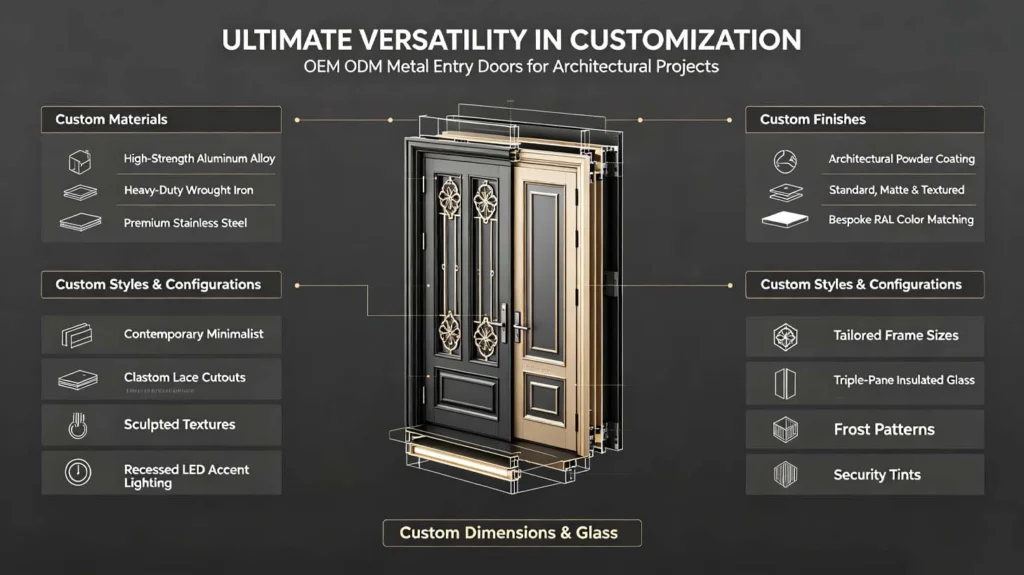
Custom composite doors should be configured according to entrance dimensions, architectural style, operating environment and performance requirements. The main customization options include:
- Door Dimensions and Thickness: Door width, height and overall thickness are determined by the opening dimensions, installation method and intended application. Non-standard sizes may require corresponding adjustments to the internal frame and reinforcement structure.
- Panel Styles and Designs: Flat panels, decorative lines, geometric patterns and other panel designs can be developed to match different architectural styles without compromising structural requirements.
- Surface Colors and Finishes: Powder coating supports different colors and surface effects. Coating uniformity, adhesion and batch consistency should be controlled during production.
- Glass Configurations: Glass type, thickness and dimensions can be selected according to lighting, privacy and safety requirements. The glass opening and installation structure must also match the door panel and sealing system.
- Hardware and Locking Systems: Handles, hinges, locks and sealing accessories should be selected according to door weight, opening method and security requirements. Their installation positions must match the supporting structure.
Customization Requirements and Corresponding Production Processes
| Customer Requirements | Corresponding Production Requirements |
|---|---|
| Non-standard Sizes | Non-standard dimension processing and internal structural adjustments |
| Custom Colors | Surface color, coating process and batch control |
| Special Door Designs | Panel shaping and structural design |
| Custom Glass Options | Glass specifications, opening dimensions and installation sealing |
| Hardware Customization | Hardware openings, load-bearing positions and installation accuracy |
| OEM Branding | Brand identification, product labeling and packaging customization |
💡 Frequently Asked Questions
Q: What can be customized on a composite door?
Customization can include door dimensions, thickness, panel designs, surface colors, glass configurations, hardware and branding. The final specifications should be confirmed through technical drawings and sample approval.
Custom Composite Door Manufacturing Process
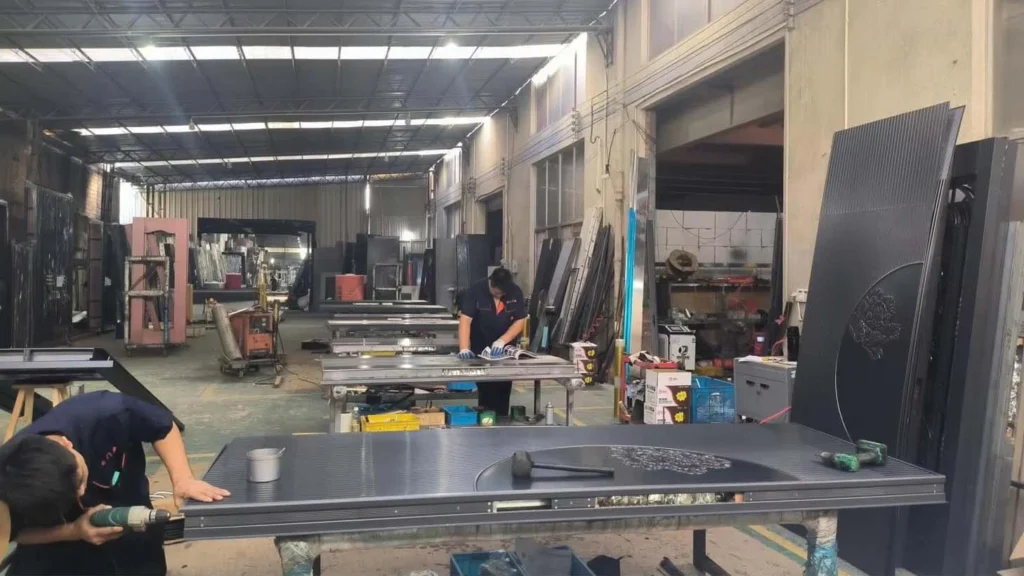
Composite door manufacturing requires coordination between the panels, internal core and metal frame to ensure dimensional accuracy and proper assembly. The main production stages include:
- Raw Material Inspection: Check aluminum alloy panel specifications, internal filling core properties and metal frame materials, including dimensions, surface conditions and material consistency.
- Aluminum Panel Processing: Complete measuring, cutting, forming and edge finishing according to production drawings, while controlling panel dimensions and processing accuracy.
- Metal Frame Fabrication: Carry out frame cutting, forming, reinforcement installation and positioning assembly to ensure structural stability.
- Core Filling and Composite Assembly: Prepare the internal core according to the design specifications and combine it with the aluminum panels and metal frame, ensuring uniform filling and stable connections.
- Surface Finishing and Final Assembly: Complete powder coating, glass installation and hardware fitting, followed by inspections of dimensions, appearance, opening functions and assembly conditions.
Established in 2008, Huaye has 18 years of manufacturing experience and a 10,000-square-meter production facility. The company provides OEM/ODM manufacturing services for customized composite door projects. Production schedules vary according to material availability, design complexity, sample approval and order quantity.
💡 Frequently Asked Questions
Q: How long does it take to manufacture custom composite doors?
Manufacturing lead time depends on material availability, design complexity, sample approval, order quantity and production scheduling. Buyers should confirm the sample and bulk production schedules with the manufacturer before placing an order.

Composite Door Quality Testing and Performance Evaluation
Composite door quality evaluation should cover dimensional accuracy, thermal performance, air permeability, water tightness, impact resistance and hardware durability. Because these doors combine multiple materials, testing should assess the complete door assembly while considering the performance of individual components, including panels, cores, frames and structural connections.
For export and construction projects, buyers should select applicable testing standards according to the target market and review the corresponding test conditions, product configurations and performance reports.
Recommended Quality Testing Items for Buyers
| Testing Item | Recommended Method or Reference Standard | Main Evaluation Criteria | Huaye Recommended Performance Targets |
|---|---|---|---|
| Dimensional Accuracy | Drawing tolerances; caliper, tape measure and square measurements | Door dimensions, thickness, diagonals and processing deviations | According to project drawings and agreed tolerances |
| Thermal Insulation | EN ISO 10077-1 / EN ISO 10077-2 | Whole-door thermal transmittance (U-value) | ≤1.5 W/(m²·K) |
| Water Tightness | EN 1027 / EN 12208 | Water penetration under different pressure conditions | Class 7A, target Class 9A |
| Air Permeability | EN 1026 / EN 12207 | Air leakage under pressure differences | Class 3, target Class 4 |
| Impact Resistance | EN 947–950 / EN 1192 | Impact resistance of door panels, frames and overall structure | Class 3, target Class 4 |
| Hardware Performance | EN 1191 / EN 12400 (where applicable) | Durability of hinges, locks and door opening and closing operations | Cycle requirements determined by application and project specifications |
Explanation of Key Performance Targets
- Thermal Insulation (U-value): A whole-door U-value of ≤1.5 W/(m²·K) is recommended as a product design target. A lower value generally indicates less heat transfer. Actual performance should be calculated or tested based on the door leaf, frame, core and other structural components.
- Water Tightness: Class 7A is recommended as a baseline target, with Class 9A as a higher performance target. Under EN 12208, these classifications correspond to test pressure levels of 300 Pa and 600 Pa, respectively. The appropriate requirement depends on the building’s exposure to wind and rain.
- Air Permeability: Class 3 is recommended as a baseline target, with Class 4 as a higher target. EN 12207 provides the relevant performance classification, with higher classes indicating better air leakage control under the specified test conditions.
- Impact Resistance: EN 1192 can be used as a reference for mechanical strength classification, with Class 3 as a baseline target and Class 4 as a higher target. The applicable class depends on the door type, test configuration and relevant impact testing method.
- Hardware Durability: Repeated opening and closing tests can evaluate the operational stability of hinges, locks and the complete door assembly. Key inspection points include smooth operation, loose connections and functional changes.
These values are recommended product performance targets for Huaye’s product development and design reference. They should not be interpreted as confirmed test results already achieved by Huaye. For formal procurement, buyers should request test reports corresponding to the specific door model, dimensions and configuration.
💡 Frequently Asked Questions
Q: How do you test the quality of composite doors?
Composite door quality is evaluated through dimensional inspections, thermal performance testing, air permeability testing, water penetration testing, impact resistance assessment and hardware durability checks. Buyers should request reports based on applicable standards and verify that the tested configuration matches the products being ordered.

Evaluating Composite Door Manufacturers and Purchasing Recommendations
Manufacturer Evaluation
Buyers should assess the following factors to determine whether a supplier has reliable composite door manufacturing capabilities:
- Structural Processing Capabilities: Confirm whether the manufacturer can process aluminum alloy panels, assemble metal frames, fill internal cores and complete composite door assembly.
- Customization and Design Capabilities: Evaluate its ability to handle non-standard dimensions, panel designs, colors, glass and hardware configurations, as well as its OEM/ODM project experience.
- Quality Control Capabilities: Review raw material inspections, in-process quality checks and finished-product testing procedures. Request relevant quality and performance reports.
- Production and Delivery Capabilities: Check factory facilities, production equipment, order scheduling, sample approval procedures and bulk production management.
- Project Service Capabilities: Consider technical communication, packaging solutions, export experience, after-sales support and warranty terms.
Established in 2008, Huaye operates a 10,000-square-meter production facility and provides OEM/ODM customization services. The company offers more than 10,000 design combinations, accepts a minimum order quantity of one piece and provides 24-hour consultation services.
Purchasing Recommendations
- Residential and High-End Building Projects: Prioritize door structure, surface finishing, glass configurations and thermal insulation to ensure that the design meets functional requirements.
- Bulk Purchasing Projects: Confirm material specifications, dimensional tolerances, color consistency and batch quality control to minimize variations between production batches.
- Special-Size and Construction Projects: Provide opening dimensions, installation conditions, door weight and hardware requirements in advance. Ask the supplier to confirm structural solutions and manufacturing feasibility.
- Export and OEM Projects: Define target market standards, testing documentation, branding, packaging specifications and warranty coverage before ordering. Confirm the final configuration through sample approval.
Before placing an order, buyers should include product drawings, material specifications, performance requirements, testing criteria and delivery conditions in the technical agreement. This helps ensure consistency between quotations, approved samples and bulk production.
💡 Frequently Asked Questions
Q: What should buyers look for in a composite door manufacturer?
Buyers should evaluate the manufacturer’s material sourcing, structural processing capabilities, customization options, quality control procedures, performance testing records and bulk production management. Clear technical specifications and sample approval procedures are also important for maintaining product consistency.
If you are sourcing composite doors for residential, commercial or construction projects, Huaye can provide OEM/ODM customization support based on your project drawings and purchasing requirements.
Contact Huaye with your door dimensions, design drawings, color preferences, glass specifications and hardware requirements to discuss the product structure, manufacturing solution and quotation.
| OEM&ODM Factory | Email:tom@huayegate.com | Whatapp:+86 13055509263 |
Selecting composite doors involves more than choosing panel materials and exterior designs. Buyers also need to consider the internal core, metal frame, manufacturing processes and overall door performance. Defining structural requirements, reviewing test reports and evaluating a manufacturer’s customization and production capabilities are essential for maintaining product quality and procurement consistency.
With appropriate structural design, process control and performance evaluation, custom composite doors can meet the dimensional, aesthetic and functional requirements of different building projects. Working with a manufacturer that offers reliable production capabilities and customization experience can also help reduce procurement and project management risks.