Key Takeaways
- Ideal Universal Fencing Alloy: 6063 aluminum alloy offers exceptional extrusion formability and surface smoothness, making it the top choice for intricate custom aluminum fence designs and powder coating finishes across over 90% of residential and commercial projects.
- High-Load Heavy-Duty Alternative: 6061 aluminum alloy delivers higher tensile strength (≥290 MPa) and yield strength, making it ideal for high-wind coastal zones, heavy cantilever gates, and high-security perimeter fencing.
- Temper Condition Dictates Performance: The T5 temper is perfectly suited for air-quenched 6063 fence profiles, while the T6 temper utilizes water quenching and artificial aging to maximize material hardness and shear resistance.
- Manufacturing Efficiency & Value: 6063 places significantly less wear on extrusion dies and offers higher production throughput, ensuring superior overall cost-effectiveness for wholesale aluminum fence procurement.
When making procurement decisions for a custom aluminum fence or organizing a wholesale aluminum fence supply chain, choosing the right alloy grade directly dictates wind-load resistance, corrosion-free lifespan, and surface coating longevity. As one of the best aluminum fence manufacturers recognized by global buyers, Huaye is frequently asked: Between 6063 and 6061 aluminum alloys, which one is truly the best fit for manufacturing aluminum fences?
Understanding 6063 and 6061 Alloys
Chemical Composition of 6063 and 6061 Aluminum
Often referred to as an “architectural aluminum alloy,” 6063 maintains silicon levels between 0.2%–0.6% and magnesium levels between 0.45%–0.9%. This precise balance provides exceptional fluid melt mobility, yielding extruded profiles with exceptionally smooth surfaces.
In contrast, 6061 is classified as a “structural aluminum alloy,” with silicon content elevated to 0.4%–0.8%, magnesium increased to 0.8%–1.2%, and additions of 0.15%–0.4% copper (Cu) and 0.04%–0.35% chromium (Cr). The introduction of copper substantially boosts tensile strength, though it slightly increases extrusion resistance.
Common Temper Conditions: T5 vs T6
During fence profile manufacturing, quenching and artificial aging (temper conditions) govern the material’s final hardness:
- T5 Temper: Profiles undergo forced air cooling directly after leaving the extrusion press, followed by artificial aging. This process preserves excellent toughness, ductility, and low thermal deformation, making it ideal for intricate 6063 fence sections.
- T6 Temper: Profiles are subjected to high-intensity water quenching (solution heat treatment) followed by artificial aging, fully activating internal crystalline mechanical properties. The Webster hardness of 6061-T6 typically reaches ≥15 HW.
💡 Frequently Asked Questions
Q: Is T5 or T6 temper state better for manufacturing aluminum fences?
A: For standard 6063 custom aluminum fence systems, the T5 temper delivers optimal structural strength (Webster hardness ≥8–10 HW), excellent dimensional stability, and superior paint adhesion. If the fence system must withstand severe hurricane wind loads or serve as heavy load-bearing posts, choosing a T6 temper in either 6061 or 6063 offers superior resistance against bending and shearing forces.
Mechanical Performance Comparison
Key benchmarks for evaluating fence quality include tensile strength thresholds, hardness performance, and long-term corrosion resistance in harsh natural environments.
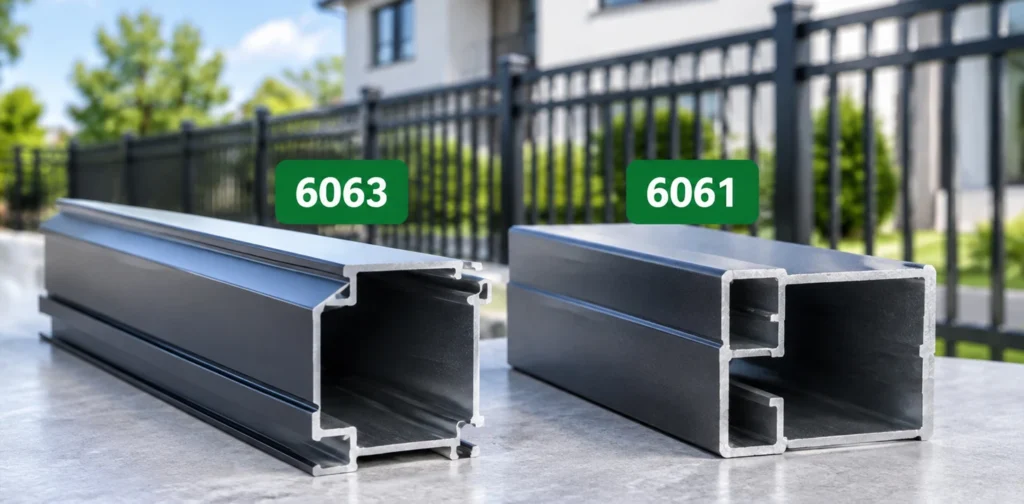
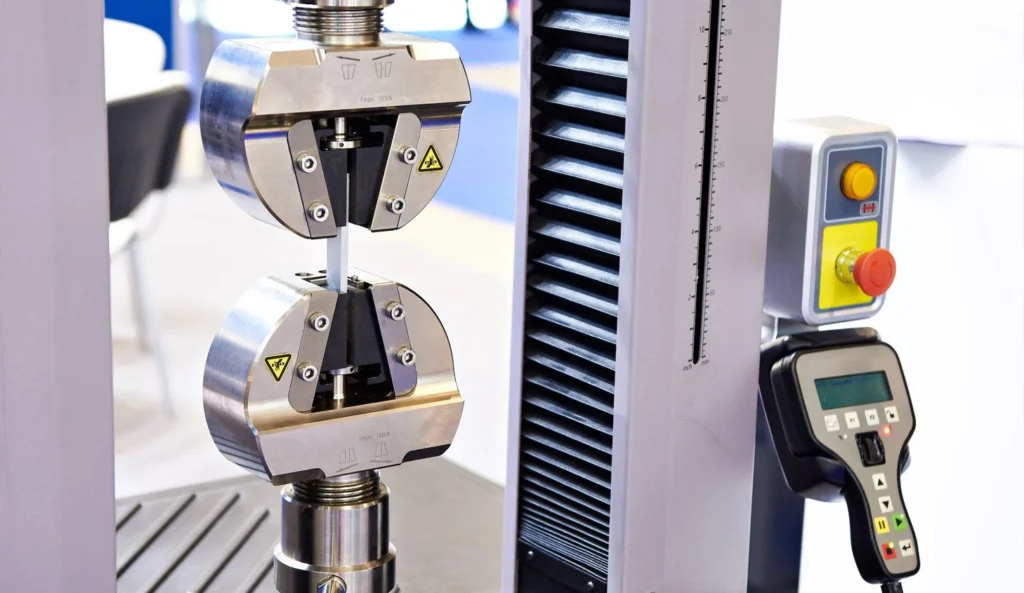
- Tensile & Yield Strength Limits: In standardized tensile testing, 6061-T6 achieves a tensile strength of ≥290 MPa and a yield strength of ≥240 MPa, whereas 6063-T5 reaches approximately ≥185 MPa tensile strength and ≥145 MPa yield strength. The higher yield point of 6061 ensures greater resistance to permanent plastic deformation under severe impacts or heavy wind loads.
- Hardness & Corrosion Resistance: 6061-T6 features a Brinell hardness of 95 HB, significantly outperforming 6063-T5 at 60 HB. However, 6063 demonstrates superior performance in corrosion resistance. Because 6061 contains trace amounts of copper (Cu), 6063 exhibits higher resistance to pitting corrosion in salt spray environments (ASTM B117 testing standards), ensuring a longer lifespan in coastal or highly humid environments.
- Extrusibility & Processing Efficiency: The extrusion speed of 6063 can reach 1.5 to 2 times that of 6061, placing far less wear on extrusion tooling. This high extrudability allows manufacturers to engineer complex snap-fit profiles with thinner wall thicknesses and internal reinforcement ribs, reducing shipping volume and installation labor for wholesale aluminum fence orders.
Comprehensive Physical & Mechanical Property Comparison Table
| Performance Property | 6063-T5 | 6061-T6 | Impact on Fence Applications |
|---|---|---|---|
| Ultimate Tensile Strength | ≥185 MPa | ≥290 MPa | 6061 offers 56% higher tensile strength for heavy-wind areas |
| Yield Strength | ≥145 MPa | ≥240 MPa | 6061 resists permanent bending deformation under severe loads |
| Elongation | 8% – 12% | 10% – 17% | Both alloys provide excellent processing toughness and ductility |
| Webster Hardness | 8 – 11 HW | 15 – 17 HW | 6061 delivers higher surface scratch resistance |
| Corrosion Resistance | Excellent | Good | 6063 contains no copper, providing superior resistance to atmospheric and salt-spray pitting |
| Extrusibility | Optimal (100%) | Moderate (60%) | 6063 supports intricate, thin-walled hollow profiles |
| Surface Finish Quality | Top Tier | Standard | 6063 yields flawless surfaces for powder coating and anodizing |
💡 Frequently Asked Questions
Q: Why is 6063 more widely used in the fence industry if 6061 offers higher strength?
A: Fencing is an exterior architectural feature that relies heavily on large-scale extrusion efficiency and surface aesthetics. 6063 aluminum alloy offers higher extrusion throughput and flawless surface quality, significantly lowering production costs. For the vast majority of wind-load and structural requirements, 6063-T5 provides more than enough strength while maximizing cost-efficiency.
Why 6063 Is Preferred for Fencing
Renowned as the premier architectural aluminum alloy, 6063 owes its widespread popularity in fencing manufacturing to its distinct physical characteristics.
Surface Smoothness and Anodizing Quality
- Flawless Grain Boundaries: After extrusion, 6063 alloy profiles exhibit virtually no visible grain lines or surface roughness, yielding an ultra-smooth finish.
- High Electrostatic Adhesion: During pre-treatment prior to powder coating or anodizing, 6063 demonstrates exceptional electrostatic paint attraction.
- Long-Lasting Weatherability: Powder coatings complying with Qualicoat Class 2 standards achieve a coating bond life on 6063 substrates of over 20 years without peeling or flaking.
Intricate Profile Extrusibility
- Custom Geometric Sections: Thanks to its high melt fluidity, 6063 easily extrudes into complex shapes containing hidden screw channels, interlocking snap joints, and reinforced internal ribs.
- Weldless Knock-Down Assembly: This extrudability allows a custom aluminum fence to be engineered as a modular, weldless knock-down system, saving up to 60% in container shipping volume when shipped flat-packed.
💡 Frequently Asked Questions
Q: Will powder-coated 6063 aluminum fence profiles chip or peel over time?
A: No. The fine grain structure of 6063 forms a dense conversion coating during degreasing and chromate/chrome-free passivation. Combined with automated powder coating and heat curing, paint adhesion consistently reaches Class 0 (Cross-Hatch Test ISO Class 0).
Alloy Selection by Fence Structure
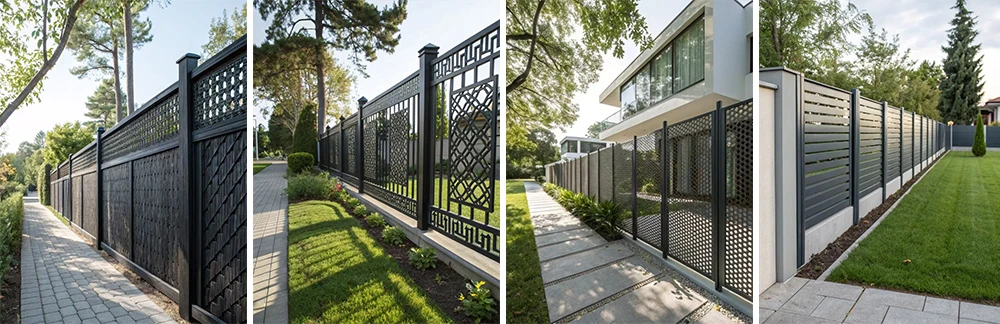
When structuring a wholesale aluminum fence procurement plan, strategically matching alloys to specific component roles optimizes both cost and performance.
To achieve the best balance, component-level material selection should follow these guidelines:
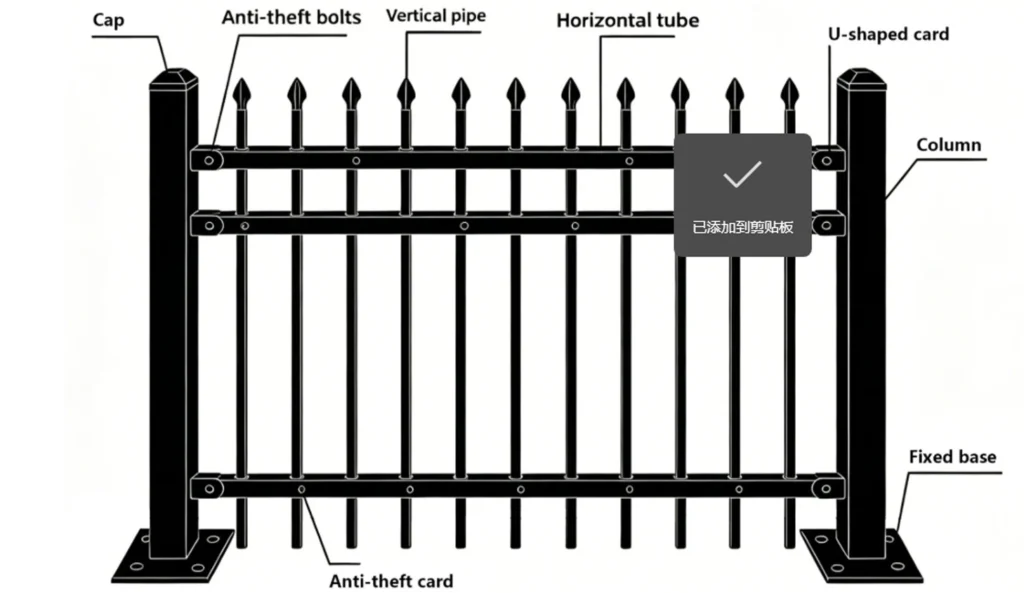
- Fence Posts: As the central load-bearing element, fence posts should use 6063-T6 or 6061-T6 profiles with wall thicknesses of ≥2.0mm.
- Horizontal Rails: Rails require punched slots to receive pickets. Utilizing 6063-T5 ensures the metal does not crack during high-speed punching while maintaining robust flexural strength.
- Pickets & Decorative Pickings: Serving primarily decorative and barrier functions, 6063-T5 allows for intricate extruded shapes and superior surface finishing.
- Custom Gate Frames: Subject to frequent opening torque and sagging stress, heavy-duty gate frames benefit from reinforced 6061-T6 welded or mechanically assembled profiles.
💡 Frequently Asked Questions
Q: Can 6063 and 6061 alloys be combined within the same fencing system?
A: Yes, absolutely. Combining alloys is a standard engineering strategy for premium projects: 6061-T6 is specified for primary load-bearing posts and gate structural frames, while 6063-T5 is used for the higher-volume, intricately shaped pickets and horizontal rails.
Huaye 18-Year Customization Strengths
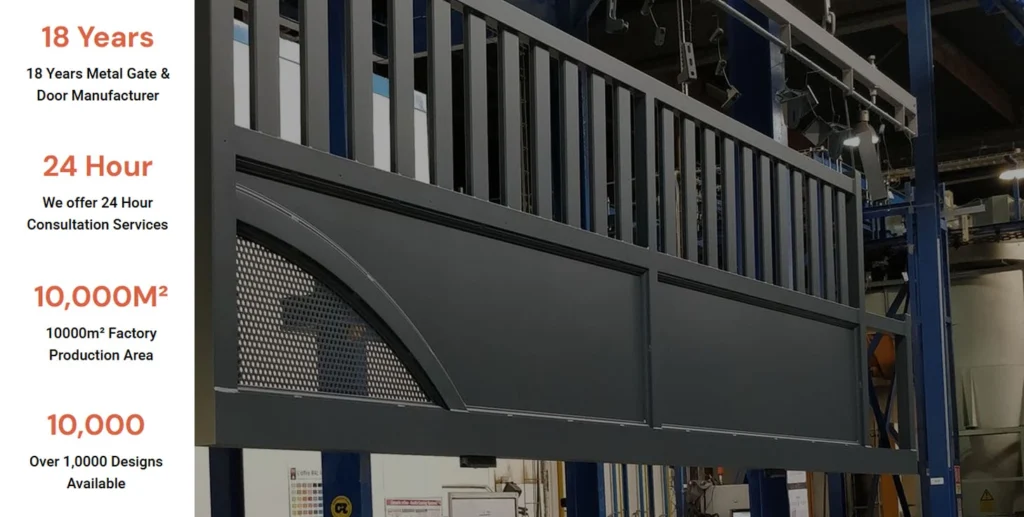
Established in 2008, Huaye brings 18 years of specialized manufacturing expertise to provide international buyers with market-leading custom aluminum fencing solutions.
- Premium Raw Material Assurance: We strictly source high-purity primary aluminum ingots to guarantee superior tensile strength and corrosion resistance from the source, firmly rejecting recycled scrap aluminum.
- Advanced Processing Capabilities: Our facilities house high-precision extrusion presses and automated powder-coating lines. Combined with seamless welding and precision stamping, our profiles deliver smoother surface finishes and superior paint adhesion.
- Modernized Manufacturing Scale: Operating out of a 10,000-square-meter standardized factory, we comfortably support high-volume production with rapid delivery schedules.
- Massive Design Options & Customization: Offering over 10,000 design combinations, colors, and hardware configurations, Huaye fully supports comprehensive OEM/ODM customization services, custom color matching, and bespoke styling to meet diverse commercial and residential demands.
- Rigorous Quality Assurance: Every incoming batch of aluminum ingots and extruded profiles undergoes spectral chemical composition analysis and Webster hardness testing. Shipments include standard Material Test Certificates (MTC) and support third-party inspection (SGS/TÜV).
💡 Frequently Asked Questions
Q: How can buyers initiate a custom or OEM aluminum fencing project with Huaye?
A: Simply submit your architectural drawings or design specifications to our engineering team. Huaye provides a complete commercial proposal covering alloy optimization (6063/6061 matching), custom color swatches, structural feasibility, and sample confirmation.
Looking for a trusted source factory for custom aluminum fences? Contact Huaye’s engineering team today to request free samples, material test reports, and 24-hour quotation support!
| OEM&ODM Factory | Email:tom@huayegate.com | Whatapp:+86 13055509263 |
Selecting between 6063 and 6061 aluminum alloy comes down to balancing extrusion aesthetics, corrosion longevity, and structural strength. 6063 aluminum alloy remains the primary workhorse for standard custom and bulk wholesale fencing due to its superior surface finish and extrusion flexibility. Meanwhile, 6061 aluminum alloy offers unmatched structural integrity for heavy wind loads and high-stress gate frames.
Leveraging 18 years of metal manufacturing heritage and a 10,000 m² production base, Huaye as one of the best aluminum fence manufacturers remains committed to providing global buyers with cost-effective, high-performance aluminum fencing solutions tailored to exact project requirements.