Table of contents
Current Status and Development Trends of the US Custom External Door Market
In the US residential and building upgrade market, door systems are shifting from standardized products to high-performance, customizable custom external doors solutions. This change is mainly driven by the growth of renovation demand and the improvement of energy efficiency standards.
According to relevant research from the Harvard Joint Center for Housing Studies (JCHS), residential renovation spending has maintained long-term growth, with window and door system upgrades accounting for a stable proportion, indicating that exterior doors have become an important component affecting building energy consumption and overall value.
Current market trends are as follows:
- Demand continues to grow: Residential renovation and new construction projects jointly drive demand for door replacement, especially in the existing housing market.
- Material diversification: Wood doors are used in high-end residences, fiberglass doors have become the main growth driver, and steel doors are mainly used in commercial and high-security scenarios.
- Stricter energy efficiency standards: ENERGY STAR and NFRC standards are pushing external door manufacturers to continuously optimize insulation and sealing performance.
Overall, the US exterior door market is moving toward higher energy efficiency, stronger customization, and more systematic solutions.
Top 5 Custom External Door Manufacturers in the US
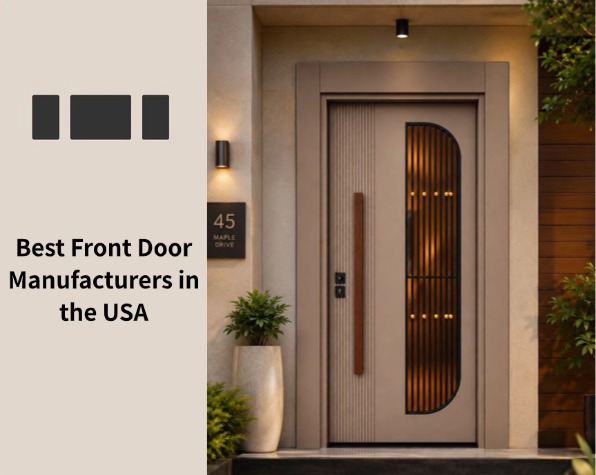
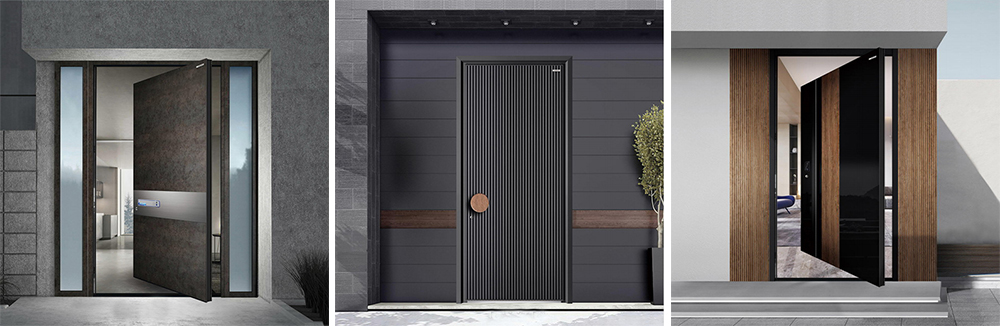
In the US exterior door industry, there are not many manufacturers with nationwide influence that can cover residential, commercial, and high-end architectural projects. The following five companies are representative in terms of brand history, technical capability, market share, and engineering applications, forming the core landscape of the North American custom external door market.
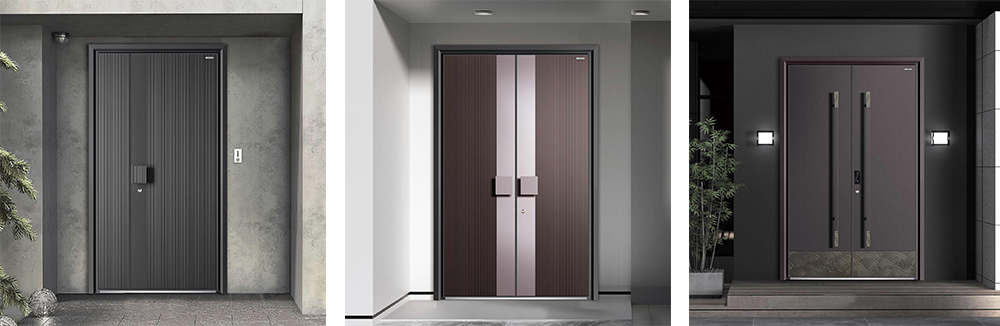
1. Huaye (Custom Metal External Door OEM Manufacturer)
Huaye was established in 2008 and has about 18 years of experience in custom metal door manufacturing, focusing on custom external doors and engineering-grade entrance door systems, and providing OEM/ODM services, widely used in customized procurement for residential, commercial, and engineering projects.
In terms of overall manufacturing and delivery capability, Huaye’s advantages are mainly reflected in the combination of scaled production and high customization capability, which can be divided into the following aspects:
- Factory scale and production capacity foundation: With a manufacturing plant of about 10,000 square meters, equipped with complete metal processing and surface treatment production lines, it supports an integrated production process from design, cutting, welding to spraying and assembly, meeting the delivery requirements of bulk orders and engineering projects.
- OEM/ODM customization capability: Supports brand cooperation and engineering customization development, allowing structural design, appearance style, and functional configuration adjustments according to customer requirements, suitable for different markets and project standards.
- Product design system and selection range: Can provide more than 10,000 door design combinations, covering door structures, surface styles, color schemes, and glass and hardware matching systems, meeting diverse architectural design requirements.
- Material application system: Mainly uses aluminum, iron, and stainless steel materials, among which high-strength aluminum alloy is widely applied, featuring strong corrosion resistance, anti-rust properties, and structural stability, suitable for various climates and building environments.
- Customization flexibility and MOQ: Supports multi-dimensional customization including color, style, texture, and pattern, while providing flexible production with MOQ starting from 1 piece, suitable for sample development, small-batch projects, and customized engineering orders.
Overall, Huaye’s core advantage in the metal door field lies not only in high customization flexibility, but also in its 10,000-square-meter factory scale and systematic production capability, enabling it to serve as a highly adaptable manufacturing role in the global external door manufacturers supply chain system.
2. Pella Corporation
Pella Corporation, founded in 1925, is one of the oldest and most recognized premium door and window brands in the United States, mainly targeting mid-to-high-end residential and architectural design projects in the custom external door market.
- Brand history and market positioning: With nearly a century of development, it has strong brand influence in high-end residential and architectural design markets.
- Comprehensive product structure: Covers wood doors, fiberglass doors, and steel exterior doors, meeting different architectural styles and performance requirements.
- Outstanding energy efficiency performance: Most products comply with ENERGY STAR standards, with mature technology in insulation and sealing systems.
- Strong customization capability: Supports multiple style customization including modern, traditional, and architect-designed series, adaptable to different design languages.
3. Andersen Corporation
Andersen Corporation is one of the important leading brands in the US window and door industry, known for its Fibrex composite material technology and sustainable manufacturing system, widely used in high-end residential and energy-efficient buildings.
- Innovative material system (Fibrex technology): Uses a composite structure of wood fiber and polymer materials, improving deformation resistance and weather durability.
- Energy-saving and environmental manufacturing philosophy: Emphasizes low-energy production processes and sustainable material usage, aligning with green building trends.
- Wide product application range: Suitable for high-end residences, new residential construction, and energy-efficient renovation projects.
- Customization capability: Supports multiple appearance styles and structural configurations to meet integrated architectural design requirements.
4. JELD-WEN
JELD-WEN, founded in 1960, is a globally established door and window manufacturer with extensive engineering and retail channels in North America.
- Comprehensive product coverage: Provides wood doors, steel doors, and composite material doors, meeting different price and performance requirements.
- Strong large-scale production capability: Has a mature global supply chain system with strong mass production capacity.
- Obvious cost-performance advantage: Highly competitive in mid-range residential and engineering projects.
- Wide distribution channels: Products are widely distributed through retailers, contractors, and engineering channels.
5. Therma-Tru
Therma-Tru is a representative brand in the fiberglass exterior door industry and is widely regarded as an important driver of the North American fiberglass door market.
- Leading fiberglass door technology: Outstanding performance in deformation resistance, moisture resistance, and structural stability.
- Low maintenance cost advantage: Compared with traditional wood doors, it is more weather-resistant and requires lower long-term maintenance.
- Excellent energy efficiency performance: Products typically feature low U-factor values, suitable for energy-efficient residential projects.
- Strong appearance simulation capability: Can achieve highly realistic wood grain effects, combining aesthetics and functionality.
- High market penetration: Widely used in the North American residential market and is a mainstream exterior door choice.
How to Choose Suitable Custom External Doors
Choosing suitable custom external doors requires balancing performance, safety, and long-term cost rather than focusing only on appearance. A well-selected door directly impacts energy efficiency, durability, and overall building comfort.
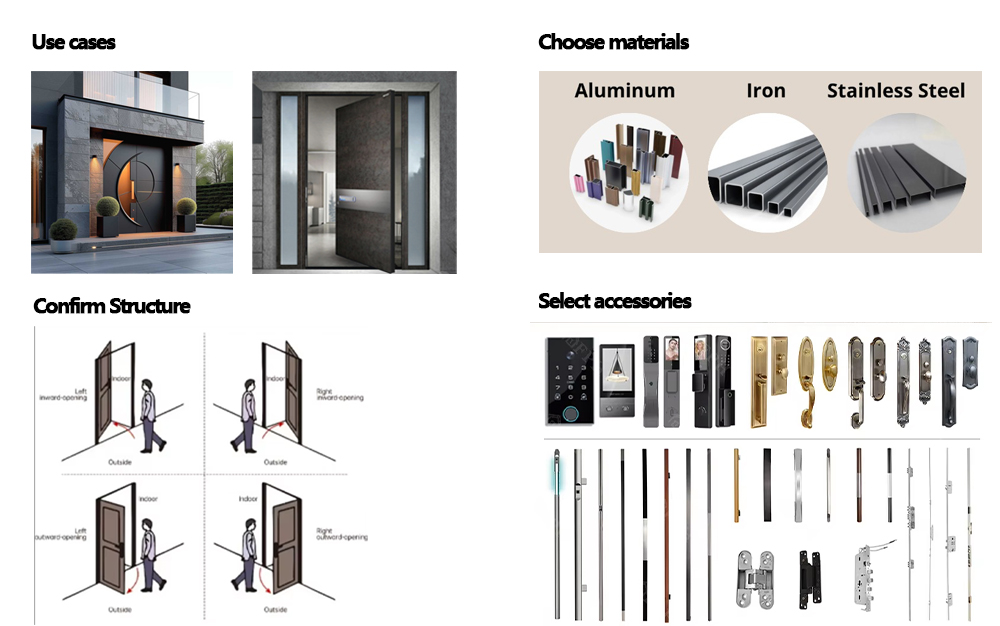
- Define usage scenarios and functional needs: Residential doors prioritize insulation and aesthetic coordination, commercial doors focus on durability and frequent use performance, while high-security applications require stronger anti-pry structures and advanced locking systems.
- Select appropriate materials: Wood doors offer a premium look but require higher maintenance. Fiberglass doors provide balanced insulation and weather resistance, making them a mainstream choice. Steel doors deliver higher strength and are suitable for commercial or security-focused environments.
- Check energy efficiency performance: ENERGY STAR and NFRC standards are key references. Lower U-factor values indicate better thermal insulation, while lower air leakage improves sealing performance, directly affecting long-term energy consumption.
- Confirm dimensions and structure: Accurate measurement is essential for proper installation and sealing. Common options include single, double, and French doors, each suited to different architectural layouts and space requirements.
- Select hardware and security systems: Modern door systems often include multi-point locking, anti-pry reinforcement, and smart lock compatibility, improving both safety and convenience.
Global Supply Chain and OEM Manufacturing Role
As the US exterior door market demands higher customization and cost efficiency, the role of global supply chains in the external door manufacturers system has become increasingly important, and OEM/ODM models have become mainstream cooperation methods.
- Global supply chain division model: US brands focus more on design and distribution, while manufacturing is increasingly outsourced globally to reduce costs and improve delivery efficiency.
- OEM/ODM industry value: Through division of labor, the”brand design + factory production” model ensures consistency while improving customization flexibility.
- Growing demand from engineering projects: Large residential and commercial projects require more non-standard sizes and customized appearance of custom external doors , driving flexible manufacturing development.
Huaye’s Role in the OEM Manufacturing System
In the global exterior door OEM/ODM cooperation system, Huaye mainly undertakes manufacturing and customized delivery of engineering-grade metal doors. Its role is more reflected in both ” structural execution” and “mass production support” on the mid-to-late supply chain side, serving brand owners and engineering contractors.
- Engineering-grade manufacturing and systematic production capability: Huaye relies on a 10,000-square-meter production base and complete metal processing system, covering the full manufacturing process from cutting, welding, surface treatment to final assembly, supporting stable batch delivery of various metal door specifications in engineering projects.
- Non-standard customization and structural adaptation capability: According to different market and project requirements, structural, dimensional, and appearance adjustments can be made to better adapt to diverse architectural standards in residential and commercial buildings.
- Flexible production capacity and order response mechanism: In the context of growing demand for custom external doors, standardized and modular production systems enable efficient coordination of multi-batch, small-batch, and mixed orders with consistent output.
| OEM&ODM Factory | mailto:tom@huayegate.com | Whatapp:+86 13055509263 |
Overall, the five major US exterior door manufacturers show a clear tiered market structure: high-end architectural brands focus on design and craftsmanship, mid-range brands emphasize cost-effectiveness and large-scale delivery, while OEM manufacturing systems provide important support in the global supply chain.
When making decisions, users should focus on three key factors: building usage, climate conditions, and long-term maintenance costs. custom external doors are not just a product choice but a long-term performance investment decision, directly affecting energy efficiency, safety, and user experience.
At the same time, understanding the differences among external door manufacturers helps better match project requirements and avoid decision bias caused by price or appearance alone.
By combining professional manufacturers and stable supply chain resources, a better balance can usually be achieved among cost, performance, and delivery, ultimately resulting in higher-quality building outcomes.